
Enabling the Operation: RAF Fairford’s Role in the Bella 1 Seizure
The Bella 1—later reflagged and renamed Marinera—became the centrepiece of one of the most dramatic maritime pursuits in recent years, a sanctioned “ghost fleet” tanker that spent weeks evading U.S. authorities across the Caribbean and North Atlantic. Sanctioned in 2024 for its role in illicit Iranian and Venezuelan oil movements, the vessel repeatedly changed identity, repainting its name and switching flags in a bid to slip through a tightening blockade. By late December it had re‑registered under the Russian flag and was being shadowed by Russian naval assets, including a submarine, as it pushed north toward the UK‑Iceland‑Greenland gap. After a two‑week chase through storms and contested waters, U.S. Coast Guard and military forces finally boarded the tanker between Iceland and Scotland, ending its flight and igniting a geopolitical flashpoint between Washington and Moscow.
As the sanctioned tanker Bella 1 — later reflagged as Marinera — edged toward the North Atlantic in early January, RAF Fairford became an unexpected focal point of one of the most unusual maritime interception operations in recent years. The quiet Gloucestershire airbase transformed into a staging hub for a surge of U.S. Special Operations aircraft, including MH‑47G Chinooks and MH‑60M Black Hawks flown in by the 160th Special Operations Aviation Regiment, as American forces prepared for a potential hostile boarding of the rogue vessel. Supported by RAF reconnaissance assets and the strategic use of UK airspace and infrastructure, Fairford played a pivotal enabling role in the multinational effort that ultimately led to the tanker’s capture in deteriorating Atlantic conditions.
Whilst we were unable to get up to RAF Fairford ourselves, the team monitored social media to stay up to date on all movements from the base. Open‑source intelligence surrounding RAF Fairford’s involvement in the Bella 1 operation quickly coalesced into a detailed, crowd‑sourced picture of the build‑up. Aviation trackers, enthusiast forums, and ADS‑B data highlighted an unusual surge of U.S. Special Operations Aviation Regiment assets arriving at Fairford—MH‑47G and MH‑60M helicopters flown in aboard C‑17s, alongside CV‑22B Ospreys and MC-130J Commando II’s —prompting early speculation that the base was being used as a forward staging point for a maritime interdiction mission. OSINT analysts cross‑referenced these movements with U.S. P‑8 patrol flights monitoring the sanctioned tanker’s north‑easterly track between Iceland and the UK, reinforcing assessments that Fairford was providing basing and logistical support for the impending seizure. As the UK Ministry of Defense later confirmed, the RAF contributed surveillance and enabling support to the U.S. interdiction effort, validating much of what the open‑source community had already pieced together from flight logs, satellite imagery, and real‑time tracking feeds. New Year’s Day saw the first movement with a Boeing 737‑73W(BBJ) flying in from Rota, Spain and departing to Pope Air Force Base the following day.
Over the following three days, no fewer than 14 Boeing C‑17A Globemaster IIIs passed through RAF Fairford, the majority from the continental USA, including Fort Campbell, Kentucky—home of the Regimental Headquarters and 1st Battalion, 160th Special Operations Aviation Regiment (Airborne)—Hunter Army Airfield, Georgia, home of 3rd Battalion, 160th SOAR(A), as well as NAS Oceana–Virginia Beach, home of the Naval Special Warfare Development Group (DEVGRU/SEAL Team 6).
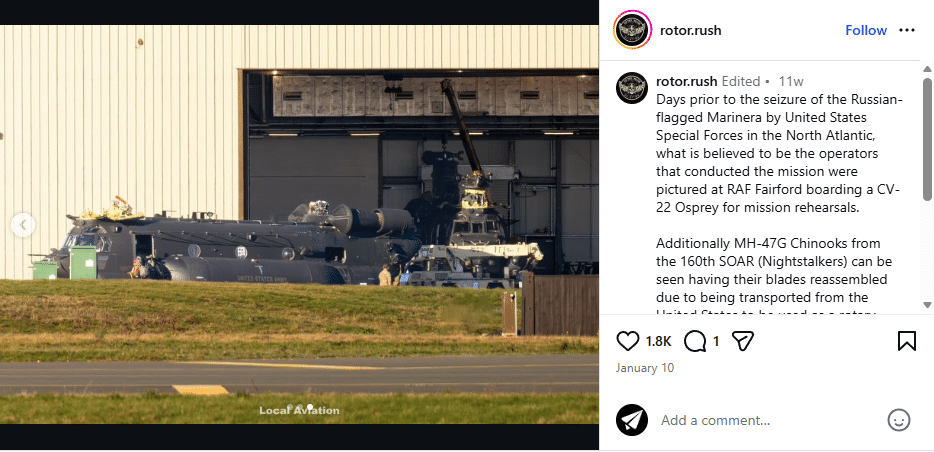
The 160th Special Operations Aviation Regiment (Airborne)—the famed “Night Stalkers”—is one of the U.S. Army’s most elite and specialized aviation units, renowned for its mastery of low‑visibility, high‑risk missions. Operating MH‑47 Chinooks, MH‑60 Black Hawks, and the stealthy MH‑6/AH‑6 Little Birds, the regiment is built around precision, speed, and the ability to insert or extract special operations forces in the most hostile environments. Its crews train relentlessly to fly at night, at low level, and in adverse conditions that would ground most other aircraft. With a culture defined by quiet professionalism and the motto “Night Stalkers Don’t Quit,” the 160th SOAR(A) has played a pivotal role in countless operations worldwide, earning a reputation as the tip of the spear for U.S. special operations aviation.
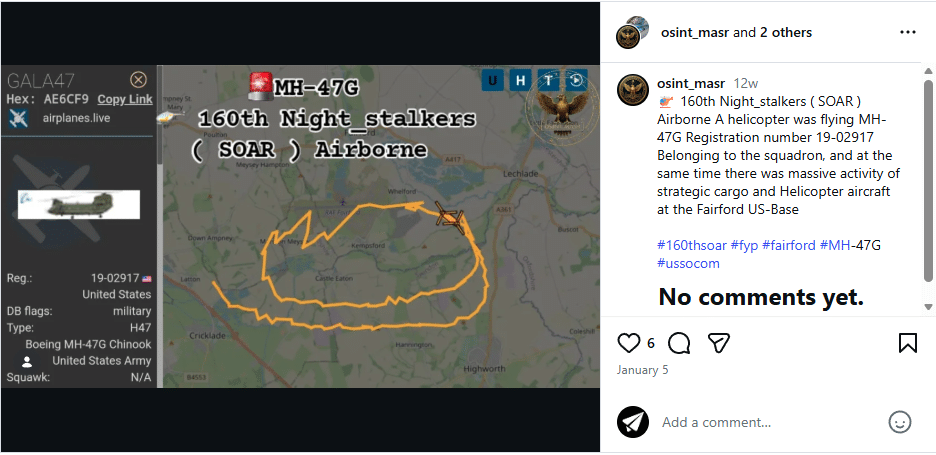
By Sunday 4th January, Bell/Boeing CV‑22B Ospreys from 7th SOS, 352nd SOW were transiting to and from RAF Fairford from their home base at RAF Mildenhall, whilst the Boeing MH‑47G Chinooks and Sikorsky MH‑60M Black Hawks of 1‑160th SOAR were being prepared for flight, with Gala47, a Boeing MH‑47G Chinook, taking to the RAF Fairford circuit at 02:30hrs on the morning of Monday 5th January.
Two of the most clandestine aircraft involved in the mission were a CASA C‑295W, callsign Reach45, and a CASA/Airtech CN‑235‑300, reported as using Bakere3 and Reach510 as callsigns. Both aircraft are operated by the 427th SOS at Pope AFB. The 427th Special Operations Squadron is one of the more discreet units within Air Force Special Operations Command, operating in the shadows to support some of the U.S. military’s most sensitive missions. Often associated with training, equipping, and providing specialized aviation support to partner forces and other U.S. special operations elements, the squadron focuses on capabilities that fall outside the traditional airpower toolkit. Its work spans unconventional aviation, covert mobility, and enabling clandestine operations where subtlety, adaptability, and low‑visibility execution are essential. While much of what the 427th SOS does remains classified, its reputation reflects a unit designed to bridge gaps—delivering unique air support options that complement the broader special operations community and expand the U.S. military’s ability to operate in complex, politically delicate environments.
A relatively new addition to the 67th SOS, 352nd SOW, the civilian‑looking Dornier 328‑110 C‑146A Wolfhound provided logistical support to the operation, flying multiple sorties between RAF Mildenhall, RAF Fairford, and RAF Lossiemouth under the callsign Daddy11. This was likely connected to the intelligence‑gathering mission carried out by U.S. Navy Boeing 737‑800A P‑8A Poseidon’s operating out of Keflavik, Iceland and RAF Mildenhall, along with Boeing 737‑800A Poseidon MRA.1s from RAF Lossiemouth and a single sortie by an RAF Waddington‑based Boeing RC‑135W Rivet Joint.
It was clear that the United States Department of Defense wanted to be seen preparing for the operation, with troops conducting winching and fast‑roping exercises with Bell/Boeing CV‑22B Ospreys from 7th SOS, 352nd SOW at the 27 threshold in full view of spotters and anyone driving along Whelford Road. By this point, not only had snow moved in at RAF Fairford, but also a large proportion of 7th SOS, 352nd SOW, with up to five Bell/Boeing CV‑22B Ospreys observed at the base.
As the Bella 1 steamed north into the Greenland–Iceland–United Kingdom (GIUK) gap, the United States military proceeded with the boarding of the ship. Initially reported by Russia Today, those of us who had been following the build‑up at RAF Fairford were shocked to see footage taken by the crew of the Bella 1 showing a Hughes MH‑6M Cayuse approaching the bridge of the ship. As the day went on and more details emerged, it became clear that none of the 160th Special Operations Aviation Regiment (Airborne) assets that had arrived into RAF Fairford in the previous days had been involved. Instead, four Bell/Boeing CV‑22B Ospreys and two Lockheed Martin MC‑130J Commando IIs departed RAF Fairford shortly after 07:30hrs, supported by further MC‑130Js and Boeing KC‑135Rs operating out of RAF Mildenhall.
Saturday 10th January appeared relatively quiet, with a single Boeing C‑17A Globemaster III departing to Glasgow‑Prestwick, only to return the next day—this time with six Hughes MH‑6M Cayuse onboard. It was mobile‑phone footage from crew members aboard the Bella 1 showing a Hughes MH‑6M Cayuse approaching the ship that first surfaced in mainstream media, leading to speculation that the operation to seize the Bella 1 had commenced. By this point, a number of the other 160th SOAR assets had begun to be broken down ready for onward transportation, and by 16th January all airframes and support equipment had left RAF Fairford.
Article by Matt Sudol
© South West Aviation Photographers 2026